

As city lights begin to glow, more and more cycling enthusiasts choose to ride through the streets at night, enjoying the cool breeze and a sense of freedom. However, night riding also brings hidden dangers—low visibility, vehicle blind spots, and increased accident risks. As a core piece of night-riding gear, helmets with integrated lights are becoming an “invisible armor” for cyclists, thanks to rapid technological upgrades.
1. Night Riding Risks: The Overlooked “Visual Blind Spots”
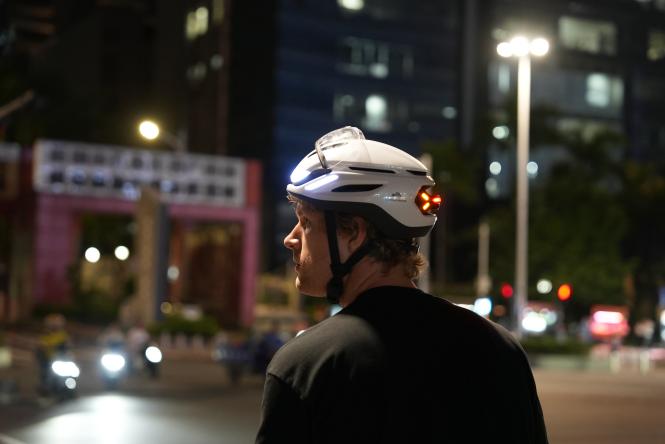
According to global cycling safety reports, the accident rate for night riding is 3.2 times higher than during the day. The main reasons include:
- Drivers’ perspective: In low-light conditions, cyclists without active light sources are easily overlooked by motorists.
- Cyclists’ own visibility: Glare from streetlights and vehicle headlights can interfere with vision, making potholes, pedestrians, and obstacles harder to detect.
- Limitations of traditional gear: Handlebar lights and reflective strips only cover limited directions and struggle to handle complex urban traffic environments.
Behind these statistics lie real safety pain points for cyclists. The emergence of light-equipped helmets directly addresses the root issue—insufficient visibility.
2. The Technological Evolution of Lighted Helmets: From Passive Reflection to Active Warning
1. Core Lighting Technologies
- Front White LED Light
Featuring high-lumen lens designs, with illumination distances of up to 10 meters, these lights not only brighten the road ahead but also allow oncoming vehicles to detect cyclists from 20 meters away. - Rear Warning Light
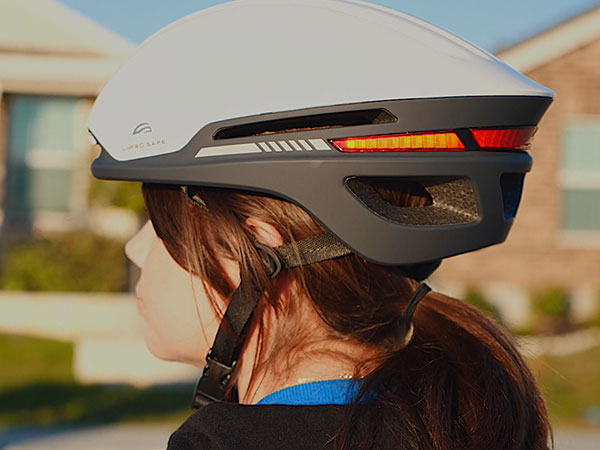
Multi-mode lighting options (steady on / slow flash / rapid flash) significantly enhance visibility. In rain or fog, warning distances can exceed 100 meters. - Smart Sensor Systems
Some high-end models include built-in accelerometers that trigger high-frequency flashing during braking, further reducing the risk of rear-end collisions.
2. Safety Upgrades Beyond Lighting
A high-quality lighted helmet is more than just a lighting device—it’s a protective fortress:
- In-Mold Protective Structure
Using EPS foam combined with a PC outer shell, the helmet effectively disperses impact forces and meets CE (EU) and CPSC (U.S.) safety standards. - Ventilation & Heat Dissipation
Aerodynamic airflow channels paired with quick-dry inner padding keep riders cool and comfortable, even on long rides. - Lightweight Design
With total weight typically between 300–400 grams, these helmets offer comfort comparable to traditional helmets.
3. How to Choose the Right Lighted Helmet for You
1. Lighting Configuration
- Daily commuting: A basic model with a front light of ≥80 lumens and a rear flashing light is usually sufficient.
- Long-distance night rides: Look for helmets with USB-C fast charging and battery life of 8 hours or more to avoid running out of power mid-ride.
2. Fit & Wearing Experience
- Adjustment system: A rear adjustment dial plus removable, washable padding ensures a secure and comfortable fit.
- Compatibility: Glasses-friendly design with dedicated slots for eyewear arms.
- Water resistance: IPX65 or higher waterproof rating provides confidence during unexpected rain.
4. The Future: Helmets as Intelligent Cycling Hubs
With the advancement of IoT technology, lighted helmets are evolving beyond lighting into fully integrated smart systems, potentially including:
- Bluetooth communication: Hands-free calls and voice navigation without reaching for your phone.
- Crash detection: Built-in gyroscopes that automatically send location data to emergency contacts after an accident.
- Solar charging panels: Supplementary charging through sunlight during rides, reducing battery anxiety.
For urban cyclists, helmet lights have long surpassed the simple function of illumination. They represent the fusion of technology and safety, a serious commitment to protecting every night ride. When you ride through the city after dark wearing one, you’re not only able to see the road ahead clearly—you’re also ensuring that the world can clearly see you.